What is AI ( artificial intelligence)?
Artificial intelligence (AI) refers to the simulation of human intelligence in machines that are programmed to think like humans and mimic their actions. The term may also be applied to any machine that exhibits traits associated with a human mind such as learning and problem-solving.
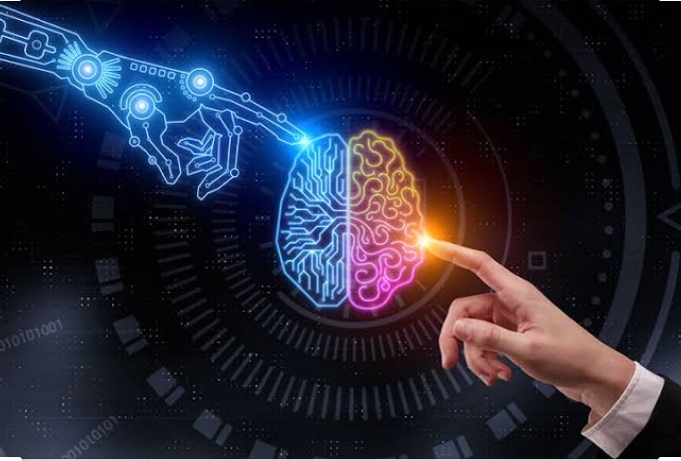
Work of AI ,Where AI exist?
AI (artificial intelligence) you had seen or used many of website in daily life when you search a thing ,like or unlike a page or a video or a image ,buy a thing , comment in page ,etc the main working computer of that website analysis and give your purpose think as you like or need or some time you think to buy ,that computers are a basically programmed as AI . Normally AI are not talk but some high-tech AI are also talk like our daily friend google assistant and they are also talk by messages like help support in Google when you contact to help or support and you also take a answer but there was not any human that was an AI and not in Google many of site have AI for help or support.
Here are many ways to start learning AI ( artificial intelligence)
1. Online courses
2. Book ( soft copy or hard copy)
3. Programming
4. Phylosophy
5. Free content
6. Code
7. Videos
8. Learning
9. Organisation
10. Movies
Online courses
- MIT Artifical Intelligence Videos – MIT AI Course
- Intro to Artificial Intelligence – Learn the Fundamentals of AI. Course run by Peter Norvig
- EdX Artificial Intelligence – The course will introduce the basic ideas and techniques underlying the design of intelligent computer systems
- Artificial Intelligence For Robotics – This class will teach you basic methods in Artificial Intelligence, including: probabilistic inference, planning and search, localization, tracking and control, all with a focus on robotics
- Machine Learning – Basic machine learning algorithms for supervised and unsupervised learning
- Neural Networks For Machine Learning – Algorithmic and practical tricks for artifical neural networks.
- Stanford Statistical Learning – Introductory course on machine learning focusing on: linear and polynomial regression, logistic regression and linear discriminant analysis; cross-validation and the bootstrap, model selection and regularization methods (ridge and lasso); nonlinear models, splines and generalized additive models; tree-based methods, random forests and boosting; support-vector machines.
- Knowledge Based Artificial Intelligence – Georgia Tech’s course on Artificial Intelligence focussing on Symbolic AI.
Books ( here search this book in this website internet archive )
- Artificial Intelligence: A Modern Approach – Stuart Russell & Peter Norvig
- Also consider browsing the list of recommended reading, divided by each chapter in “Artificial Intelligence: A Modern Approach”.
- Paradigms Of Artificial Intelligence Programming: Case Studies in Common Lisp – Paradigms of AI Programming is the first text to teach advanced Common Lisp techniques in the context of building major AI systems
- Reinforcement Learning: An Introduction – This introductory textbook on reinforcement learning is targeted toward engineers and scientists in artificial intelligence, operations research, neural networks, and control systems, and we hope it will also be of interest to psychologists and neuroscientists.
- The Cambridge Handbook Of Artificial Intelligence – Written for non-specialists, it covers the discipline’s foundations, major theories, and principal research areas, plus related topics such as artificial life
- The Emotion Machine: Commonsense Thinking, Artificial Intelligence, and the Future of the Human Mind – In this mind-expanding book, scientific pioneer Marvin Minsky continues his groundbreaking research, offering a fascinating new model for how our minds work
- Artificial Intelligence: A New Synthesis – Beginning with elementary reactive agents, Nilsson gradually increases their cognitive horsepower to illustrate the most important and lasting ideas in AI
- On Intelligence – Hawkins develops a powerful theory of how the human brain works, explaining why computers are not intelligent and how, based on this new theory, we can finally build intelligent machines. Also audio version available from audible.com
- How To Create A Mind – Kurzweil discusses how the brain works, how the mind emerges, brain-computer interfaces, and the implications of vastly increasing the powers of our intelligence to address the world’s problems
If you want its pdf and you don’t get in archive website the please comment me to solve this issue.
Programming
- Prolog Programming For Artificial Intelligence – This best-selling guide to Prolog and Artificial Intelligence concentrates on the art of using the basic mechanisms of Prolog to solve interesting AI problems.
- AI Algorithms, Data Structures and Idioms in Prolog, Lisp and Java – PDF here
- Python Tools for Machine Learning
- Python for Artificial Intelligence
Phylosophy
- Super Intelligence – Superintelligence asks the questions: What happens when machines surpass humans in general intelligence. A really great book.
- Our Final Invention: Artificial Intelligence And The End Of The Human Era – Our Final Invention explores the perils of the heedless pursuit of advanced AI. Until now, human intelligence has had no rival. Can we coexist with beings whose intelligence dwarfs our own? And will they allow us to?
- How to Create a Mind: The Secret of Human Thought Revealed – Ray Kurzweil, director of engineering at Google, explored the process of reverse-engineering the brain to understand precisely how it works, then applies that knowledge to create vastly intelligent machines.
- Minds, Brains, And Programs – The 1980 paper by philospher John Searle that contains the famous ‘Chinese Room’ thought experiment. Probably the most famous attack on the notion of a Strong AI possessing a ‘mind’ or a ‘consciousness’, and interesting reading for those interested in the intersection of AI and philosophy of mind.
Free content
- Foundations Of Computational Agents – This book is published by Cambridge University Press, 2010
- The Quest For Artificial Intelligence – This book traces the history of the subject, from the early dreams of eighteenth-century (and earlier) pioneers to the more successful work of today’s AI engineers.
- Artificial Intelligence | Machine Learning – Andrew Ng (Notes, lectures, and problems)
- Computers and Thought: A practical Introduction to Artificial Intelligence – The book covers computer simulation of human activities, such as problem solving and natural language understanding; computer vision; AI tools and techniques; an introduction to AI programming; symbolic and neural network models of cognition; the nature of mind and intelligence; and the social implications of AI and cognitive science.
- Society of Mind – Marvin Minsky’s seminal work on how our mind works. Lot of Symbolic AI concepts have been derived from this basis.
- Artificial Intelligence and Molecular Biology – The current volume is an effort to bridge that range of exploration, from nucleotide to abstract concept, in contemporary AI/MB research.
- Brief Introduction To Educational Implications Of Artificial Intelligence – This book is designed to help preservice and inservice teachers learn about some of the educational implications of current uses of Artificial Intelligence as an aid to solving problems and accomplishing tasks.
- Encyclopedia: Computational intelligence – Scholarpedia is a peer-reviewed open-access encyclopedia written and maintained by scholarly experts from around the world.
- Ethical Artificial Intelligence – a book by Bill Hibbard that combines several peer reviewed papers and new material to analyze the issues of ethical artificial intelligence.
Code
- AIMACode – Source code for “Artificial Intelligence: A Modern Approach” in Common Lisp, Java, Python. More to come.
- FANN – Fast Artificial Neural Network Library, native for C
Videos
- A tutorial on Deep Learning
- Basics of Computational Reinforcement Learning
- Deep Reinforcement Learning
- Intelligent agents and paradigms for AI
- The Unreasonable Effectiveness Of Deep Learning – The Director of Facebook’s AI Research, Dr. Yann LeCun gives a talk on deep convolutional neural networks and their applications to machine learning and computer vision
Learning
- Deep Learning. Methods And Applications Free book from Microsoft Research
- Neural Networks And Deep Learning – Neural networks and deep learning currently provide the best solutions to many problems in image recognition, speech recognition, and natural language processing. This book will teach you the core concepts behind neural networks and deep learning
- Machine Learning: A Probabilistic Perspective – This textbook offers a comprehensive and self-contained introduction to the field of machine learning, based on a unified, probabilistic approach
- Deep Learning – Yoshua Bengio, Ian Goodfellow and Aaron Courville put together this currently free (and draft version) book on deep learning. The book is kept up-to-date and covers a wide range of topics in depth (up to and including sequence-to-sequence learning).
- Getting Started with Deep Learning and Python
- Machine Learning Mastery
- Deep Learning.net – Aggregation site for DL resources
- Awesome Machine Learning – Like this Github, but ML-focused
- FastML
Organisation
- IEEE Computational Intelligence Society
- Machine Intelligence Research Institute
- OpenAI
- Association For The Advancement of Artificial Intelligence
Movies
- 2001: A Space Odyssey
- A.I. Artificial Intelligence
- Automata
- Blade Runner
- Chappie
- Ex Machina
- Her
- I, Robot
- Prometheus
- The Terminator
- Transcendence
If you are also interested in Physics and programming so please follow me or if you like this please also like .This all thing i am trying and also thing you also learn Of any problems you get please comment. Thank you…………







 Physics